
School & Career Counselling, Kindergarten to career
Seven stages of school and career counselling, each matched to your ward's age, online or at our office in R.S. Puram, Coimbatore. Throughout the school years, The Pathway Programme follows your ward through a short weekly check-in, one activity and a Monthly Pathway Note every month, and a written report every 3 months. After Class 12, we guide admissions in India and abroad, and for graduates and professionals, career guidance continues for life.
Choose your ward's stage
{{stage.num}}
{{stage.name}}
{{stage.grades}} · {{stage.ages}}
{{stage.intro}}
What your ward does
- {{x.t}}
What you receive
- {{x.t}}
Questions we explore
- {{x.t}}
Completed by: {{stage.by}}
{{stage.feeLabel}}: {{stage.fee}}
Kindergarten to Class 12 · Subscription
The Pathway Programme
A structured subscription that follows your ward week by week, mainly in writing, with a one-to-one session when your ward needs one. Up to Class 8, you share weekly observations; from Class 9, your ward completes a weekly check-in and you add a monthly update. Every month brings one simple activity and a short Monthly Pathway Note, and every 3 months you receive a written report with clear next steps. Small, regular observations reveal far more than any single test.
Junior · Kindergarten to Class 8Parent-led check-ins
Senior · Class 9 to 12Student-led check-ins
Pay monthly, quarterly or yearly. Monthly plans have a minimum of 3 months. The exact fee for your ward's stage is shared on your free parent call, and it is the same for every family.
Every week
A two-minute check-in on WhatsApp: from you up to Class 8, from your ward from Class 9.
Every month
One simple activity at home, and a short Monthly Pathway Note from your counsellor on what we noticed.
Every 3 months
A written progress report from your counsellor, with clear next steps for your ward.
Your Pathway Passport
Every week adds a page. A personal record of your ward's strengths, updated every 3 months to guide the stream decision and career roadmap.
Start with a free parent call.
15 minutes, with no obligation. Call-backs between 11 am and 4 pm.
Prefer to pay once?
One-time options for key decisions.
A one-time plan for one clear decision. Fees are shared on your free parent call.
Stream Decision Report
For students joining in Class 10. Written assessment and a stream recommendation.
Career Roadmap
For Class 11 – 12 students. Exams, colleges and a personal action plan.
College admissions in India
Shortlisting, scholarships and application support after Class 12.
First Career Plan
Ages 18 – 24: first career choice, higher studies or a first job.
Career Transition Plan
Ages 25 – 54: growth, a change of field or a return to work.
Next Chapter Plan
Ages 55 and above: planning for before and after retirement.
Career Companion
Any age from 18: weekly written check-ins, a monthly review and your CPD record, while you make a change. Minimum 3 months.
Study abroad
Universities, scholarships, applications, visas and loans, through our Global Education wing.
Global best practice
The world's best school systems start career guidance early.
In these countries, career education is a planned part of school life from the early years. We bring the same approach to families in India and abroad, and many of these countries are also where our students go on to study.
Scotland, UK
A national Career Education Standard for ages 3 to 18
Ontario, Canada
Career and life planning from Kindergarten to Grade 12
United States
School counsellors guide career development from Kindergarten to Grade 12
Japan
Every school keeps a Career Passport for students, from primary to high school
South Korea
An exam-free “Free Semester” in middle school, set aside for career exploration
Finland
Study and career guidance throughout school, with guidance counselling in Grades 7 to 9
Germany
A strengths assessment in Grade 7 or 8, followed by hands-on career days
Singapore
Education and Career Guidance, with career exploration tools from Primary 5
What the research shows
When does a career take shape, and how does it grow?
A career is not chosen at one moment. Research that has followed people for many years shows that it takes shape in stages, from the early school years to retirement. Each of our programmes is matched to one of these stages.
The research answer: A career direction often begins to take shape between ages 14 and 17 (Class 9 to 12). The years before are for discovering strengths, and the years after bring new decisions: first jobs, career changes and, finally, retirement. Good guidance is lifelong.
Ages 3 – 7
Kindergarten – Class 2
Early awareness
What research shows
Ideas about jobs come from family and television. By age 7, many children already rule some jobs out.
What we do
Weekly parent check-ins that notice strengths early, with no labels.
The Pathway Programme · Junior
Ages 8 – 10
Class 3 – 5
Interests appear
What research shows
Interests begin to show, but they change often at this age.
What we do
Interests and strengths recorded week by week in the Pathway Passport.
The Pathway Programme · Junior
Ages 11 – 13
Class 6 – 8
Exploration
What research shows
Students begin judging jobs by status and narrowing their choices, often too early.
What we do
The Exploration Term widens choices before they narrow.
The Pathway Programme · Junior
Career direction takes shape
Ages 14 – 15
Class 9 – 10
Interests settle
What research shows
Interests become steadier, and students start choosing by their own abilities.
What we do
Student-led check-ins and a written stream recommendation before Class 11.
The Pathway Programme · Senior, or Stream Decision Report
Career direction takes shape
Ages 16 – 17
Class 11 – 12
Direction
What research shows
A career field and course take shape, alongside entrance exams.
What we do
A personal career roadmap, in India or abroad.
The Pathway Programme · Senior, or Career Roadmap
Ages 18 – 24
College and first job
Testing choices
What research shows
Choices are still being tested. In long-running US research, nearly half of all the jobs people hold in a working life are held before age 25.
What we do
Admissions in India or abroad, and the first career decision.
College Admissions · Study Abroad · First Career Plan
Ages 25 – 54
Working life
Growth and change
What research shows
Careers grow, but change is normal. The same research finds people hold around 12 to 13 jobs between ages 18 and 56, and each change means exploring and deciding again.
What we do
A written plan for growth, a change of field or a return to work, with a CPD record of new skills.
Career Transition Plan · Career Companion
Ages 55 and above
Before and after retirement
A new chapter
What research shows
Planning ahead helps. Meaningful part-time work after retirement is linked to greater life satisfaction.
What we do
Planning part-time work, mentoring, teaching or a new interest.
Next Chapter Plan
That is why we never decide a career in Kindergarten. We build understanding early, so that the stream decision in Class 10 and the career choice in Class 12 are made calmly, with evidence, and we stay available for every career decision that follows, through to retirement.
Our signature features
Two ideas, built for your family.
Created by THE IMPERIAL PATHWAYS from internationally recognised career-development research, adapted for Indian families, and 13+ years of guiding students. Both are part of The Pathway Programme.
Built on research
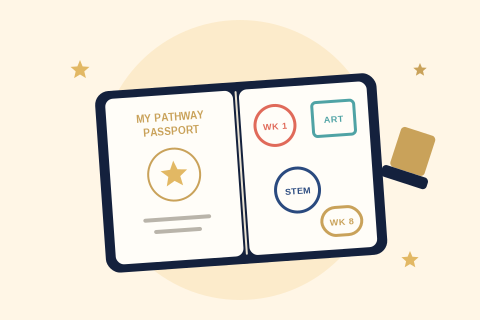
The Pathway Passport
Every week adds a page to your ward's Pathway Passport.
Every student on The Pathway Programme receives a personal Pathway Passport: a written record of strengths, interests, achievements and goals, started when your ward joins and updated with every report.
- Begins in Kindergarten, or whenever your ward joins
- Updated every 3 months, and yours to keep
- Guides the stream decision, college applications and career choices

Built on experience
The Exploration Term
Our experience shows that middle school is the best time to explore, not decide. So in Class 6 to 8, one term each year is devoted purely to discovery, with no tests and no pressure to choose.
- A new career field to explore every few weeks
- Simple at-home activities and written reflections
- Every discovery recorded in your ward's Pathway Passport
For working professionals
Continuing Professional Development (CPD)
CPD is the ongoing process of tracking, documenting and building your skills, knowledge and experience throughout your career. We help you set learning goals, choose the right courses and certifications, and keep a clear written CPD record that supports promotions, job changes and applications in India or abroad.
- A yearly CPD plan with clear learning goals
- A written record of courses, skills and achievements
- A review every 3 months, with next steps
Our written method
The same careful process at every stage.
1
Questions at home
Your ward, or you for younger students, completes the stage questionnaire in your own time.
2
Careful analysis
A qualified counsellor studies every weekly check-in and monthly activity, and writes a short note each month.
3
Written report
You receive a clear report on your ward's strengths, written so the whole family can understand it.
4
Step-by-step roadmap
Practical actions for the year ahead, refreshed as your ward moves to the next stage.